

Introduction
Every enterprise-grade platform started as a single idea tested by a small team on a tight budget. Spotify launched as a simple desktop music player. Airbnb started with three air mattresses and a borrowed camera. Figma began as a browser-based design tool that most professionals initially dismissed.
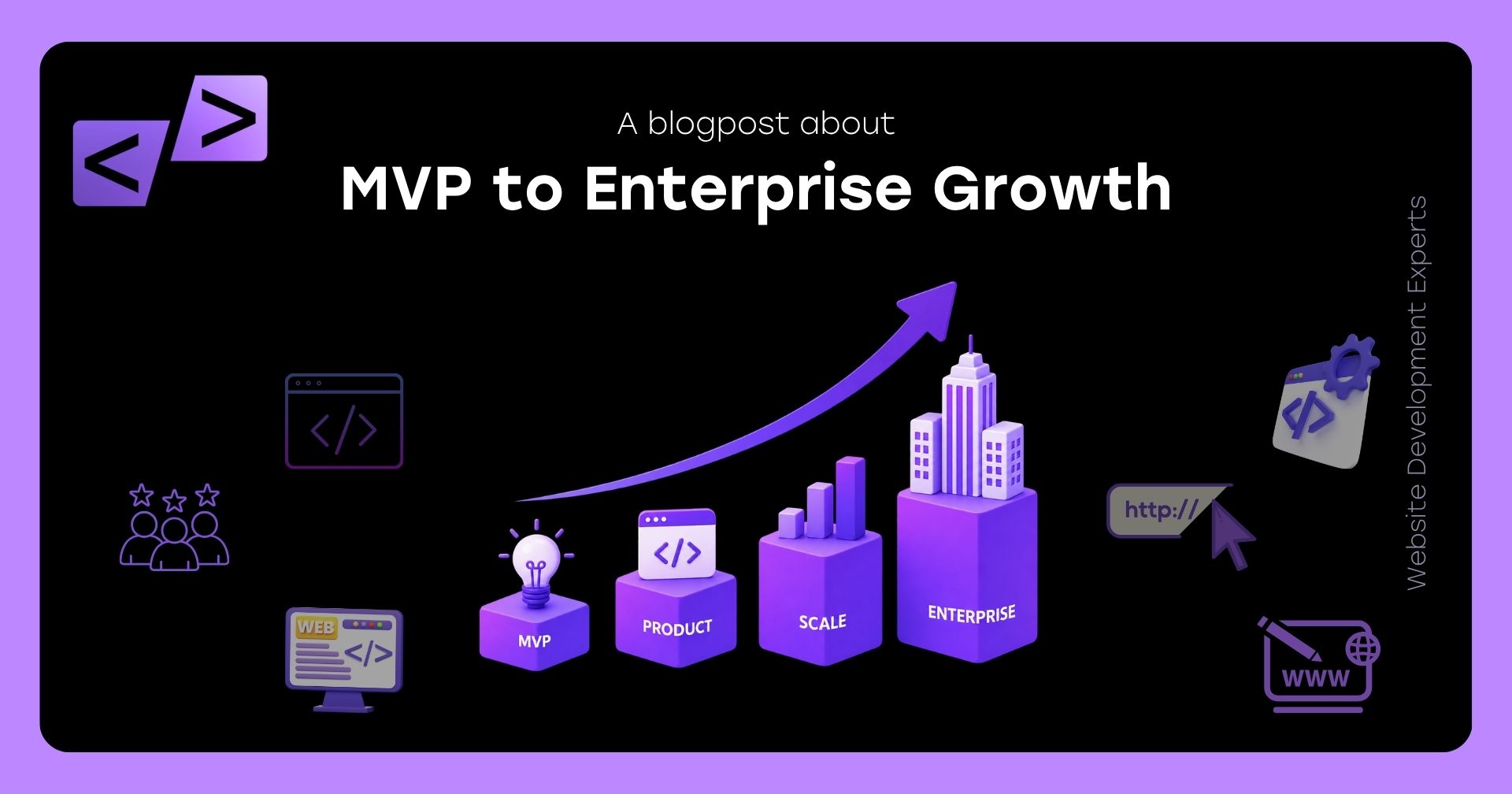
What transformed these products from minimum viable experiments into global enterprise platforms was not luck. It was a disciplined, stage-by-stage approach to adapting their technology, architecture, and web application development services to match the demands of each growth phase — without losing the speed that made them viable in the first place.
Initial traction is not an indicator of persistent scale. The very same fast decision-making, casual procedures, and tightly integrated systems that make an MVP successful may prove to be the source of structural vulnerability when it comes to the demands of an enterprise.
This guide maps the complete journey from MVP to enterprise — what changes at each stage, which decisions are irreversible, how to adapt your web application development services engagement as your product grows, and what it takes to make sure growth strengthens your platform rather than exposes its limits.
Understanding the Journey: Why MVP and Enterprise Are Fundamentally Different Products
Before exploring how to adapt, it is worth being precise about what you are adapting from and to — because MVP and enterprise are not just different sizes of the same thing. They are different products built on different principles for different goals.
An MVP is designed for validation. Not scale. Most MVPs are built to answer one question: will people use this product? Once that question is answered, the next set of questions arrives fast — and if the MVP architecture was built with shortcuts, these new requirements expose every weak point.
What an MVP is optimized for:
- Speed to market — getting a testable product in front of real users as fast as possible
- Minimum feature scope — building only what is necessary to validate the core hypothesis
- Low initial cost — keeping burn rate manageable while product-market fit is unproven
- Learning velocity — generating user feedback that informs the next iteration
- Flexibility — pivoting quickly when the market signals that something needs to change
What an enterprise platform is optimized for:
- Reliability at scale — consistent performance under high concurrent load from thousands of users
- Security and compliance — enterprise-grade data protection, regulatory adherence, and audit trails
- Operational efficiency — integrations with CRM, ERP, billing, analytics, and third-party systems
- Governance and access control — role-based permissions, team administration, and organizational hierarchy
- Extensibility — the ability to add features, enter new markets, and serve new user segments without rebuilding core systems
- Long-term maintainability — clean, documented code that a growing team can work on without institutional knowledge dependencies
When you hire an experienced development team, you are not just paying for lines of code. You are paying for the expertise to navigate the trade-offs between getting to market fast and building to last. This is the core difference between a disposable prototype and a viable, scalable business asset.
The businesses that navigate this journey successfully are those that understand from the very beginning that the MVP is a learning vehicle — and that the enterprise platform is what gets built when the learning is done.
Stage 1: The MVP — Validate Fast, Learn Faster
What the MVP Stage Is Really For
43% of failed ventures were affected by poor product-market fit. Building a full product before proving demand is the most expensive version of a mistake you could avoid in week two.
The MVP stage exists to prove — with real users, real behavior, and real data — that your product solves a problem people care enough about to engage with, pay for, or return to. Every hour of development time spent on features that go untested by real users is waste. The MVP discipline is the discipline of minimum: doing the least possible to answer the most important question.
What belongs in an MVP — and what does not:
MVP Architecture Principles That Protect the Future
The most consequential decisions in the entire MVP-to-enterprise journey are the ones made during the MVP stage. Even though an MVP starts small, successful products often experience rapid growth once product-market fit appears — and the best MVP architectures balance rapid development with a foundation that supports future growth.
Architecture decisions that must be right even at MVP stage:
- Choose a scalable tech stack from day one: Next.js has become the dominant React framework for production applications in 2026. The framework handles server-side rendering, static site generation, and API routes within a single codebase. TypeScript integration catches errors during development rather than production, reducing bugs that reach users. Choosing a stack that cannot grow with you is the single most expensive MVP decision you can make
- API-first design: Build every feature as an API endpoint from the start — not as tightly coupled server-rendered logic. This keeps your options open for mobile clients, third-party integrations, and architectural evolution
- Clean module boundaries: Even in a monolith, separate your concerns clearly — authentication, core business logic, notifications, billing. Clean boundaries at MVP stage make service decomposition dramatically easier later
- Environment parity: Local development, staging, and production should mirror each other from day one. Teams that skip this at MVP stage spend enormous time debugging environment-specific issues at scale
- Basic observability: Error tracking (Sentry), application logs, and uptime monitoring should be in place before the first real user touches the product. You cannot learn from failures you cannot see
What to Measure at the MVP Stage
The MVP stage is not about revenue. It is about signal. The metrics that matter are behavioral:
- Activation rate: What percentage of new users complete the core action that defines your value proposition?
- Retention: Do users return in week 2, week 4, and week 8 after their first session?
- Engagement depth: Are users exploring more of the product over time, or stuck on the same surface?
- Qualitative feedback: What do users say when asked why they came back — or why they left?
- Time to value: How long does it take a new user to experience the core benefit for the first time?
If you treat your MVP as a learning system rather than a finished product, every iteration brings you closer to a scalable business rather than a stalled idea.
Stage 2: Product-Market Fit — The Pivot Point Between MVP and Scale
Recognizing Product-Market Fit
Product-market fit is the inflection point where user behavior stops looking like polite experimentation and starts looking like genuine dependency. It is the moment when retention curves flatten instead of declining, when word-of-mouth starts driving acquisition without paid effort, and when users become genuinely distressed at the thought of the product disappearing.
You should start thinking about platform readiness the moment your MVP shows signs of product-market fit. Waiting too long creates a situation where scaling requires rebuilding core parts of the product while business pressure keeps increasing.
Signs that product-market fit has arrived:
- Organic user growth is accelerating without proportional marketing spend
- Retention at 30 and 90 days is meaningfully higher than industry benchmarks
- Users are requesting features rather than asking basic "how does this work" questions
- Your support queue is filling with power-user edge cases — not fundamental confusion
- Revenue per user is increasing as users find more ways to extract value
- Users are recommending the product to colleagues without being prompted
What Must Change at Product-Market Fit
This is the stage where the technical debt accumulated during rapid MVP development must be addressed — before the load of growth makes addressing it impossibly expensive.
The fast decision-making and tightly integrated systems that make an MVP successful become structural vulnerabilities at enterprise scale. The transition requires disciplined investment in the platform's foundation precisely when business pressure to add features is at its highest.
The product-market fit technical checklist:
- Architecture audit: Identify every shortcut taken during MVP development and classify each as acceptable technical debt (can be addressed incrementally) or structural risk (must be addressed before scaling)
- Database review: Review schema design, indexing strategy, and query performance under projected 10x data volume. Problems are far cheaper to fix now than at scale
- Security hardening: Move from "good enough for MVP" to enterprise-grade authentication, encryption, input validation, and compliance readiness
- Performance baseline: Establish Core Web Vitals benchmarks and load test against 10x current traffic. Identify bottlenecks before they become incidents
- Documentation: Create the architectural documentation that a growing team will need to work effectively on the codebase without depending on the original developers' institutional knowledge
Stage 3: Growth Stage — Building the Platform That Scale Requires
The Infrastructure Transformation
Instead of two-year roadmaps requiring full organizational buy-in, leading enterprises in 2026 are testing ideas with real users in weeks, not quarters. This agile approach to growth means the platform must support continuous, rapid feature delivery without compromising stability or performance.
The growth stage is where your web application development services engagement transforms from a build-and-iterate model into a platform engineering model. You are no longer just adding features — you are building the infrastructure that makes adding features sustainable.
Growth stage infrastructure priorities:
- Horizontal auto-scaling: Cloud-native infrastructure (AWS ECS, Kubernetes, GCP Cloud Run) that adds capacity automatically under load and removes it when demand normalizes — eliminating both performance failures and idle infrastructure cost
- Caching at every layer: Browser cache, CDN edge caching, Redis application cache, and database query cache all configured and tuned as traffic grows
- Asynchronous processing: Background job queues (Amazon SQS, RabbitMQ, Redis Streams) for email delivery, report generation, file processing, webhook delivery, and any operation that does not need to block the user's request
- CI/CD pipeline maturity: Automated testing, security scanning, and deployment pipelines that allow the growing team to ship confidently multiple times per day without manual risk assessment
- Distributed tracing: As the system grows in complexity, tools like Jaeger or AWS X-Ray make it possible to trace a single user request across multiple services and identify exactly which component is responsible for a slow response
The Feature Expansion Framework
Growth stage product development is governed by a discipline that MVP stage development often lacks: the distinction between features that deepen value for existing users and features that expand reach to new user segments.
Deepening value (retention investment):
- Advanced configuration and customization for power users
- Integrations with the tools your best users already rely on
- Analytics and reporting that help users prove value to their stakeholders
- Collaboration features that embed the product into team workflows
Expanding reach (acquisition investment):
- Onboarding optimization that reduces time-to-value for new users
- Self-service pricing tiers that serve smaller buyers previously excluded
- API and developer ecosystem that enables partner-built extensions
- Localization and internationalization for new geographic markets
The growth stage is where the product evolves from something users enjoy to something they genuinely cannot operate without. That stickiness is the foundation of the enterprise stage.
Stage 4: Enterprise Scale — The Full Platform
What Enterprise Scale Demands
Enterprise web platforms require maintainable, scalable architectures that grow with the business and adapt to evolving needs. Technical expertise must cover custom web development, cloud application development, legacy modernization, enterprise software solutions, and supporting services including UX/UI design, testing, and infrastructure.
Enterprise scale is not simply more of the growth stage. It introduces a category of requirements — compliance, governance, organizational administration, enterprise security, SLA-backed uptime — that did not exist at earlier stages and cannot be retrofitted without significant architectural work.
Enterprise-specific requirements that emerge at scale:
- Multi-tenancy: Organizational isolation, data separation, and tenant-specific customization that allow the same platform to serve hundreds of enterprise customers without data leakage between them
- Role-based access control (RBAC): Granular permission systems that give enterprise administrators control over what each user, team, and department can see and do within the platform
- Audit logging: Complete, tamper-proof records of every action taken within the platform — essential for enterprise compliance, legal discovery, and security forensics
- SSO and enterprise authentication: SAML 2.0, LDAP, and Active Directory integrations that allow enterprise IT teams to manage platform access through their existing identity infrastructure
- SLA-backed uptime: Enterprise customers require contractual uptime guarantees — typically 99.9% or 99.99% — which demand redundant infrastructure, multi-region deployment, and automated failover capabilities
- Compliance architecture: SOC 2 Type II, ISO 27001, HIPAA, GDPR, and other compliance frameworks that enterprise procurement teams require before approving vendor relationships
- Enterprise support: Dedicated customer success, priority support SLAs, and direct engineering escalation paths for critical issues
The Technology Evolution at Enterprise Scale
Costs range from $20,000 for simple apps to $300,000+ for enterprise systems. Web development in 2026 looks very different from five years ago — microservices, load balancers, caching layers, and cloud auto-scaling are standard components of enterprise architecture, with AI integration now included in 80% of enterprise software according to Gartner.
At enterprise scale, the modular monolith that served the growth stage well typically begins to show constraints. Specific, clearly bounded services — authentication, billing, notification delivery, analytics processing — may warrant decomposition into independent microservices that can be scaled, deployed, and updated independently.
This decomposition should be driven by engineering reality, not architectural fashion. The right time to extract a service is when a specific capability is genuinely constrained by the monolith — not because microservices sound more impressive on a technical roadmap.
The MVP to Enterprise Adaptation Framework
The 5 Most Common Mistakes in the MVP-to-Enterprise Journey
How Web Application Development Services Must Adapt at Each Stage
The partner relationship you need at the MVP stage is fundamentally different from what you need at enterprise scale. Choosing the right web application development company is one of the most important decisions businesses make when building a digital product. The right partner affects not only development quality but also scalability, performance, maintenance cost, and long-term return on investment.
At the MVP stage, you need a partner who moves fast, asks hard questions about scope, makes pragmatic technology choices, and builds on a foundation that will not need to be torn down when validation succeeds. The worst MVP partner is one who gold-plates an unvalidated idea.
At the product-market fit stage, you need a partner who can conduct an honest architectural audit, remediate technical debt without rebuilding everything, and help you make the investment decisions that protect your growth trajectory without over-engineering for a scale that has not arrived yet.
At the growth stage, you need a partner with genuine platform engineering capability — auto-scaling infrastructure, CI/CD maturity, observability tooling, and the architectural depth to decompose complexity as the product evolves. You also need a website maintenance and support relationship that keeps the platform reliable as deployment frequency and user volume both increase.
At enterprise scale, you need a long-term partner with deep institutional knowledge of your codebase, enterprise security and compliance expertise, and the capacity to serve as a strategic technology advisor — not just a vendor executing tickets.
At WebsiteDevelopmentExpert.com, led by Dr. Zaid Altahat — Ph.D. in Computer Science and 20+ years of engineering at Motorola, GE Healthcare, and Baxter — we have been the right partner at every one of these stages for the businesses we work with. Our custom web application development practice is built around this lifecycle: from MVP validation through growth infrastructure through enterprise platform engineering, backed by structured website maintenance and support at every stage.
We understand that the questions you need answered at MVP stage are completely different from the questions you face at enterprise scale — and we know how to answer both.
FAQs
What is the most important technical decision to make during the MVP stage of web application development?
Tech stack selection is the most consequential MVP decision — because it determines whether your application can grow without a full rebuild. Choose mainstream, widely supported technologies (Next.js, Node.js, PostgreSQL, cloud-native hosting) that have the community support, hiring pool, and performance ceiling your growth stage will eventually need. A wrong stack choice at MVP stage forces a complete rebuild at precisely the moment when growth pressure is highest and development bandwidth is most constrained.
How do I know when my MVP has achieved product-market fit and is ready to scale?
Product-market fit shows up in behavioral data, not in what users say. Look for retention curves that flatten rather than decline — users returning at 30, 60, and 90 days at a meaningfully higher rate than industry benchmarks. Look for organic acquisition beginning to outpace paid, for users requesting advanced features rather than asking basic how-to questions, and for the genuine discomfort users express at the idea of losing access to the product. When these signals are consistently present, product-market fit has arrived and the architecture audit should begin immediately.
What technical debt from the MVP stage must be addressed before scaling, and what can wait?
Structural risks that must be addressed before scaling include: database schema problems that will degrade under 10x data volume, security gaps that expose user data, authentication systems that cannot support enterprise SSO requirements, and tightly coupled architecture that prevents horizontal scaling. Acceptable debt that can be addressed incrementally includes: UI polish and consistency, non-critical performance optimizations, documentation gaps, and feature edge cases that affect a small minority of users. A professional web application development services partner conducts this audit systematically and helps you prioritize by risk, not by visibility.
When should a growing web application transition from a monolith to microservices?
Much later than most teams assume. A well-architected modular monolith handles the growth stage comfortably for most products. The right trigger for service decomposition is a specific, clearly bounded capability that is genuinely constrained by the monolith — where independent scaling, deployment, or team ownership would provide measurable benefit. Moving to microservices before this point adds significant operational complexity — distributed tracing, service mesh, deployment coordination — without the corresponding benefit. Let engineering reality drive the decision, not architectural fashion.
What role does website maintenance and support play as a web application grows from MVP to enterprise?
The role of maintenance and support grows at every stage — in scope, in criticality, and in the cost of getting it wrong. At MVP stage, it is basic bug fixes and uptime monitoring. At growth stage, it is SLA-backed response windows, performance monitoring, dependency management, and capacity planning. At enterprise scale, it is 24/7 incident response, formal change management, compliance audit support, and a dedicated relationship with engineers who have deep institutional knowledge of your codebase. A professional web application development services partner builds this progression into the engagement from day one — because the maintenance relationship is what ensures your investment appreciates rather than depreciates over time.

